Week 12
Far Right Worldwide
Soci—229
India, Brazil, Turkey, Israel–
November 17th
Reminders
Response Memo Deadline
The final response memo—which has to be between 250-400 words and posted on our Moodle Discussion Board—is due by 8:00 PM tonight.
Reminders
Final Paper Proposal
Final Paper Proposal Deadline
Your final paper proposals are due by 8:00 PM this Friday, November 21st.
Reminders
Final Paper Proposal
Reminders
Final Paper Proposal
Updates
Final Presentation and Term Paper
Updates
Final Presentation Order
You can find out when you’re presenting
via Moodle.
Updates
A note on Wednesday’s class.
The Global Far Right
Radical Politics Are Everywhere
[T]he relevance of the far right is no longer limited to Europe …, if it ever was. A democratically elected far-right leader currently governs three of the five biggest countries in the world. In the case of Jair Bolsonaro in Brazil and Donald Trump in the US, they came to power on the list of non-far-right parties. In India, Prime Minister Narendra Modi is the leader of the BJP, the party representative of the well-established and -organized Hindutva movement, which includes violent, extremist groups like the National Volunteer Organization (RSS), of which Modi has been a member since he was eight years old. And in Israel, long-term prime minister Benjamin Netanyahu has brought his right-wing Likud party more and more in line with his various far-right coalition partners.
(Mudde 2019, 22–23, EMPHASIS ADDED)
Radical Politics Are Everywhere
Bolsonaro is, of course, no longer the President of Brazil.
However, Bolsonarism lives on.
Radical Politics Are Everywhere
Four Case Studies
Likud in Israel
The Israeli Far Right
In the last two years, the actions of the Israeli far right have sent shockwaves around the world—creating a new
political cleavage in the process.
The Israeli Far Right
Views of Israel in the United States
The Israeli Far Right
Views of Israel Around the World
Israeli Democracy in Crisis
(Gidron 2023)
A Story of Mainstream Radicalization
Once considered pariahs, figures who espouse violent Jewish supremacy are now key political players—much like far-right leaders in Europe, whose parties are increasingly perceived as legitimate partners that purportedly surfed into political office on waves of mass discontent with democracy. Yet by putting all the blame for democratic backsliding—meaning the “erosion of democratic institutions, rules and norms” caused by the “actions of duly elected governments”—on the far right we may be overlooking other key actors who are central to this process in Israel and elsewhere.
(Gidron 2023, 34, EMPHASIS ADDED)
A Story of Mainstream Radicalization
A look at Likud, historically a mainstream conservative party, reveals a split in political views between voters and elites. Survey data show that among Israelis, and Likud supporters specifically, opinions on what constitutes a democracy are diffuse, but there is no overwhelming antiliberal majority that is opposed to democratic checks and balances. Yet at the elite level, Likud stands out for its extreme anti-establishment populism. The Chapel Hill Expert Survey (CHES), which assesses where political parties stand on ideology, found that Likud, in the salience of its anti-elite and anti-establishment appeals, is closer to the far-right parties of Europe than to the mainstream right.
(Gidron 2023, 34, EMPHASIS ADDED)
A Story of Mainstream Radicalization
[T]he case of Israel demonstrates the limited utility of relying on traditional distinctions in the origin and ideology of mainstream versus radical parties to understand the drivers of backsliding, as those presumed distinctions may conceal as much as they reveal. And finally, the radicalization of center-right parties is at least in part an elite-driven process that does not necessarily reflect changes in the worldviews of center-right voters.
(Gidron 2023, 34–35, EMPHASIS ADDED)
Group Discussion I
The Radicalization of Likud
The Radicalization of Likud
Preliminary analysis from Karim and Lukk’s The Radicalization of Mainstream Parties in the 21st Century
Note: Hover your or pointer over tiles for more information.
The AKP in Turkey
The Radicalization of the AKP
How meta.
The Radicalization of the AKP
Ten years ago, Erdoğan’s Turkey was hailed in Washington as an example to the Muslim world—a free-market, pro-American Islamic democracy with high growth rates, renowned cultural monuments and beautiful beaches. ‘A model partner’, Obama affirmed in 2009, as he congratulated the leader of the Justice and Development Party (AKP). Today, with perhaps 50,000 oppositionists in jail, including scores of journalists, politicians, lawyers and civil servants, Turkey is exporting radical Islamist mercenaries from its Syrian enclaves to Libya and Azerbaijan, clashing with France, Greece, Israel and Cyprus over gas-drilling rights in the Eastern Mediterranean and imposing a brutal occupation regime on swathes of what was once the autonomous Kurdish zone of Rojava.
(Tuğal 2021, 25, EMPHASIS ADDED)
The Radicalization of the AKP
The AKP’s first hegemonic formula—liberal Islamism—had united Gülenists, provincial business owners, the pious petty bourgeoisie, liberals, Kurds and the informal proletariat against secular Kemalists, the military and the far right, divided by the question of religious freedom. Its second formula, a novel Islamist neo-imperialism, united a now far-richer provincial bourgeoisie, military hardliners, conservatives and the far right against Gülenists, Kurds and liberals, polarized on the question of PKK ‘terror’. Through its crackdown after June 2015 the AKP had lost the support of even many conservative Kurdish voters, as well as alienating the left-liberal intelligentsia—the latter insignificant in electoral terms, but a blow to the government’s image at home and abroad. Nevertheless, the far right and some of the several million Syrian refugees—a loyal vote bank for Erdoğan—made up the difference.
(Tuğal 2021, 37, EMPHASIS ADDED)
The Radicalization of the AKP
How exactly did this change come about?
The Radicalization of the AKP
[I]f AKP had truly moderated, believing earnestly in pluralism, popular sovereignty, and other democratic values, how could the party have changed in such a dramatic fashion in such a short period of time? We … argue that claims that AKP had become ideologically moderate were both short-sighted and inaccurate. While the party did indeed experience political learning, having witnessed several Kemalist crackdowns on Islamist parties throughout the 1980s and 1990s, there is little evidence to suggest that the members had experienced a genuine “cognitive change” in favour of democracy. Instead, we find that AKP learned to operate strategically, pursuing their political goals without upsetting the secular state apparatus.
(Bashirov and Lancaster 2018, 1211, EMPHASIS ADDED)
The Radicalization of the AKP
We show that the disappearance of domestic and international structural constraints altered the institutional environment and created the requisite background conditions for the party’s radicalization. Radicalization was facilitated by what we call “Erdoganization”, an ongoing deinstitutionalization process within which Erdogan gained complete control over the party. Additionally, a series of four “external shocks” threatened the party’s primary goal of gaining hegemony and caused the party to radicalize. These external shocks were the 2013 Gezi protests, the 17–25 December investigations in 2013, the June 2015 elections and the abortive coup attempt in 2016.
(Bashirov and Lancaster 2018, 37, EMPHASIS ADDED)
Group Exercise
Bolsonarism in Brazil, Hindutva in India
Bolsonarism in Brazil
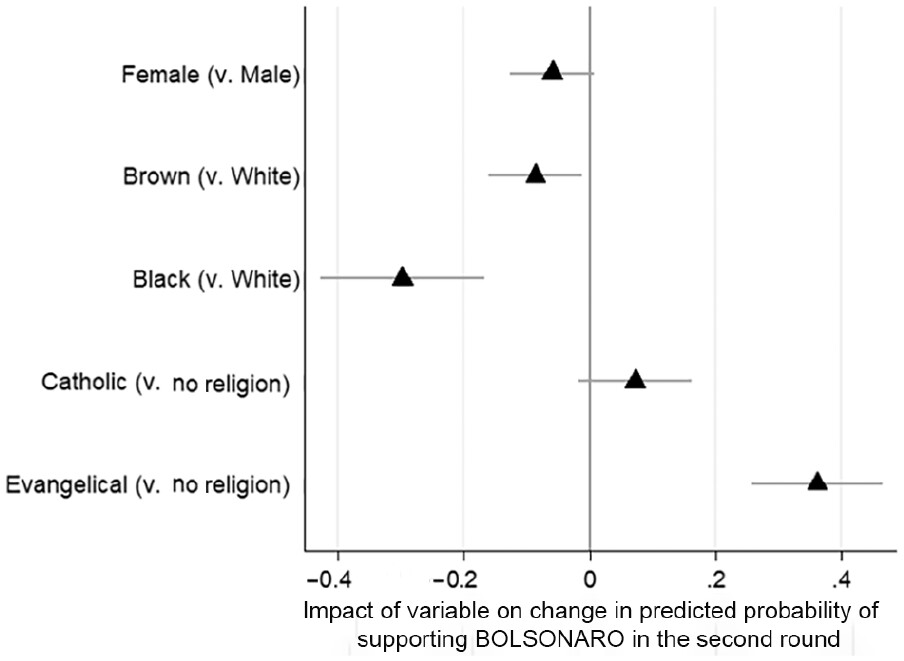
Figure 1 from Layton et al. (2021).
Bolsonarism in Brazil
Scholars have historically found that race, gender, and religion are minor determinants of vote choice in Brazil and across Latin America, emphasizing instead class-based and non-programmatic politics rooted in candidate charisma or clientelism. However, Brazil’s 2018 contest was different. Identity shaped responses to Bolsonaro’s candidacy. For certain individuals, his rhetoric and policy positions regarding minority groups represented a red flag; for others, they served as a rallying point.
(Layton et al. 2021, 25, EMPHASIS ADDED)
Hindutva in India
Just as a key aim of Jim Crow was to blunt the Reconstruction Amendments and turn blacks into second-class citizens, Hindu nationalists seek to diminish the constitutionally guaranteed equal citizenship of Muslims and turn them into marginalized, less than fully equal citizens. White supremacy and Hindu supremacy are twins in that sense … Similarity marks even the methods deployed: exclusionary laws, segregation, and vigilante violence. Just as in the Jim Crow South a combination of state-level election victories and extralegal methods was deployed to deprive blacks of their rights, Hindu nationalism is using both legislative power and extralegal methods to subdue Muslims. Vigilante violence, condoned or supported by the state, has been on the rise since Modi and his party came to power.
(Varshney and Staggs 2024, 6, EMPHASIS ADDED)
Hindutva in India
Preliminary analysis from Karim and Lukk’s The Radicalization of Mainstream Parties in the 21st Century
Note: Hover your or pointer over tiles for more information.
Group Discussion II
The Role of Religion
In groups of 3-4, discuss how religion is implicated in the four cases discussed in today’s class. Does religion animate radical, right-wing movements in Europe and the Anglosphere as well?
Open Work Session–
November 19th
Reminders
Final Paper Proposal
Final Paper Proposal Deadline
Your final paper proposals are due by 8:00 PM on Friday.
Reminders
Final Paper Proposal
Reminders
Final Presentation and Term Paper
Reminders
Final Presentation Order
You can find out when you’re presenting
via Moodle.
Work Session
An Informal Presentation
For the rest of today’s session, please work on your final paper proposal or the final paper itself. Towards the end of class, we’ll go around the room so everyone can present their preliminary ideas.
Enjoy the Break
References